


This is our first blog.
For a long time, we focused on building. Delivering. Solving. Shipping. We were never great at talking about what happens behind the scenes, how we think, how we structure deals, how we win them, and sometimes how we lose them.
Times change.
And if we’ve learned anything over the years, it’s this: technical expertise alone doesn’t win deals, and pure sales talent doesn’t either. What wins is the integration of both.
So let’s start with a story.
The Perfect Setup
A few years ago, when we started Cube, our structure looked ideal on paper.
We had brilliant technical people. The kind of engineers who could design complex architectures, build innovative systems, and go deep into problems most companies wouldn’t even attempt. They were builders. Thinkers. Wizards in their domain.
We also had a strong sales team. Great communicators. Strong CVs. Confident in the room. They understood our portfolio, knew our past projects, and could speak fluently about our capabilities. It looked like the perfect combination for us, for you, for every “build a business” book! So we did what many companies do. We divided the roles clearly.
Sales would open doors. Technical would deliver. We would “meet in the middle” when needed.
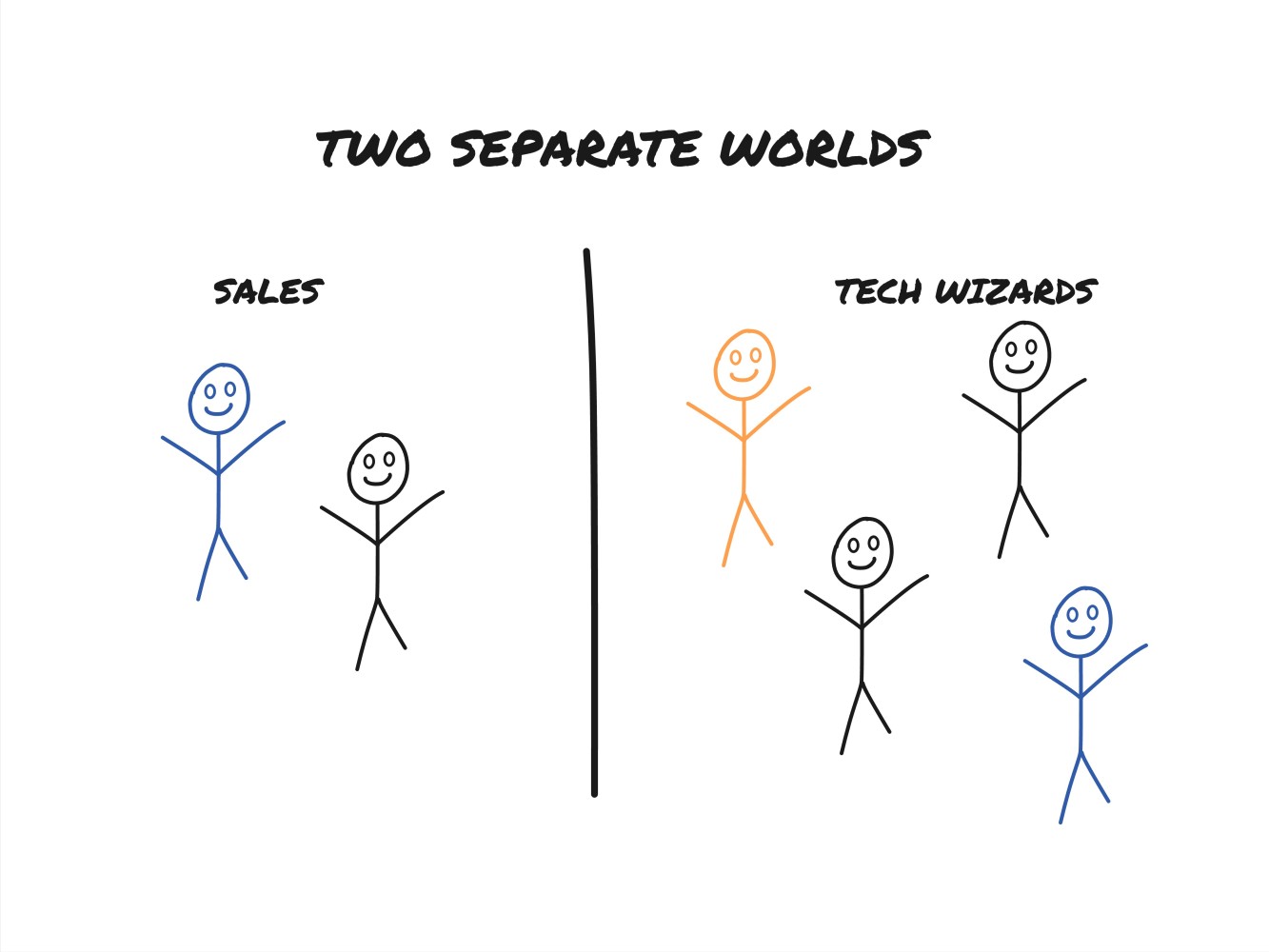
We invested heavily in exposure. Big conferences. Private dinners. Industry events. Relationship-building. The full traditional sales package.
Three months in, we had a “code red” meeting.
We had closed two major deals.
We were celebrating.
Then, in one single day, we lost both.
The Question
We weren’t angry. But we needed to understand.
Why were the deals not ours?
What did we miss?
Months later, by coincidence, our CEO met one of those potential clients at a conference and asked directly for feedback.
The answer was honest, and it was uncomfortable.
The client said our sales team was professional, passionate, and well-prepared. There was no issue with attitude or effort.
The issue was depth.
He needed a discovery conversation immediately. He had technical questions. He wanted to challenge assumptions.
He wanted to understand why we chose a specific architecture, why the cost was structured in a certain way, how the system would impact his business operations, and what exactly would change compared to his current setup.
He admitted something else: he is a controlling CEO. He does not sign contracts in the dark. He needs clarity. He needs logic. He needs to understand where every euro goes and why.
And in that process, he didn’t feel guided. He felt pitched. That difference cost us the deal.
The False Belief We Had
Until that moment, we believed something many companies still believe:
Sales is sales. Development is development. Everyone has their lane. Alignment happens “somewhere in the middle.”
That assumption was wrong.
Our clients, especially in complex digital transformation projects, don’t just buy outcomes. They buy understanding. They buy certainty. They buy logic.
They want to know:
- Why this model?
- Why this architecture?
- Why this cost?
- What changes in their system?
- What risks exist?
- What trade-offs were made?
And if those answers don’t appear during the sales cycle, they don’t disappear. They become doubts. And doubt doesn’t always show up as an objection; it shows up as silence or with a classic as “We decided to move in another direction.”
What did we change?
That moment forced us to rethink our entire approach, and that took some good months at our desks, talking until midnight and so much mental health. Outcome? we stopped separating sales and technical thinking.
We began integrating technical reasoning directly into the sales cycle. Not as a late-stage validation step, but as part of discovery, positioning, and proposal design.
We trained our sales team to truly understand the logic behind our architecture decisions, cost structures, technical trade-offs, and overall system impact, not at the depth of a developer, but at a strategic level strong enough to lead confident, high-level discussions
And also we made a structural change: a developer joined every key meeting, ensuring that when technical questions surfaced, answers were immediate, precise, and grounded in reality rather than approximation
We began involving technical leadership much earlier in the conversation, not as a reactive move when “deep questions” appeared, but as a proactive part of discovery and solution shaping.
At the same time, we completely redesigned the way we present our proposals. We moved away from surface-level feature discussions and focused instead on structural logic: why this architecture, why this model, why this investment.
And perhaps most importantly, we stopped guessing what the client needed. Instead of rushing to propose solutions, we created space, asking guided, precise questions and allowing the client to articulate their real objectives, constraints, and expectations.
Only then did we design the solution around what was actually required, not what we assumed would impress them.
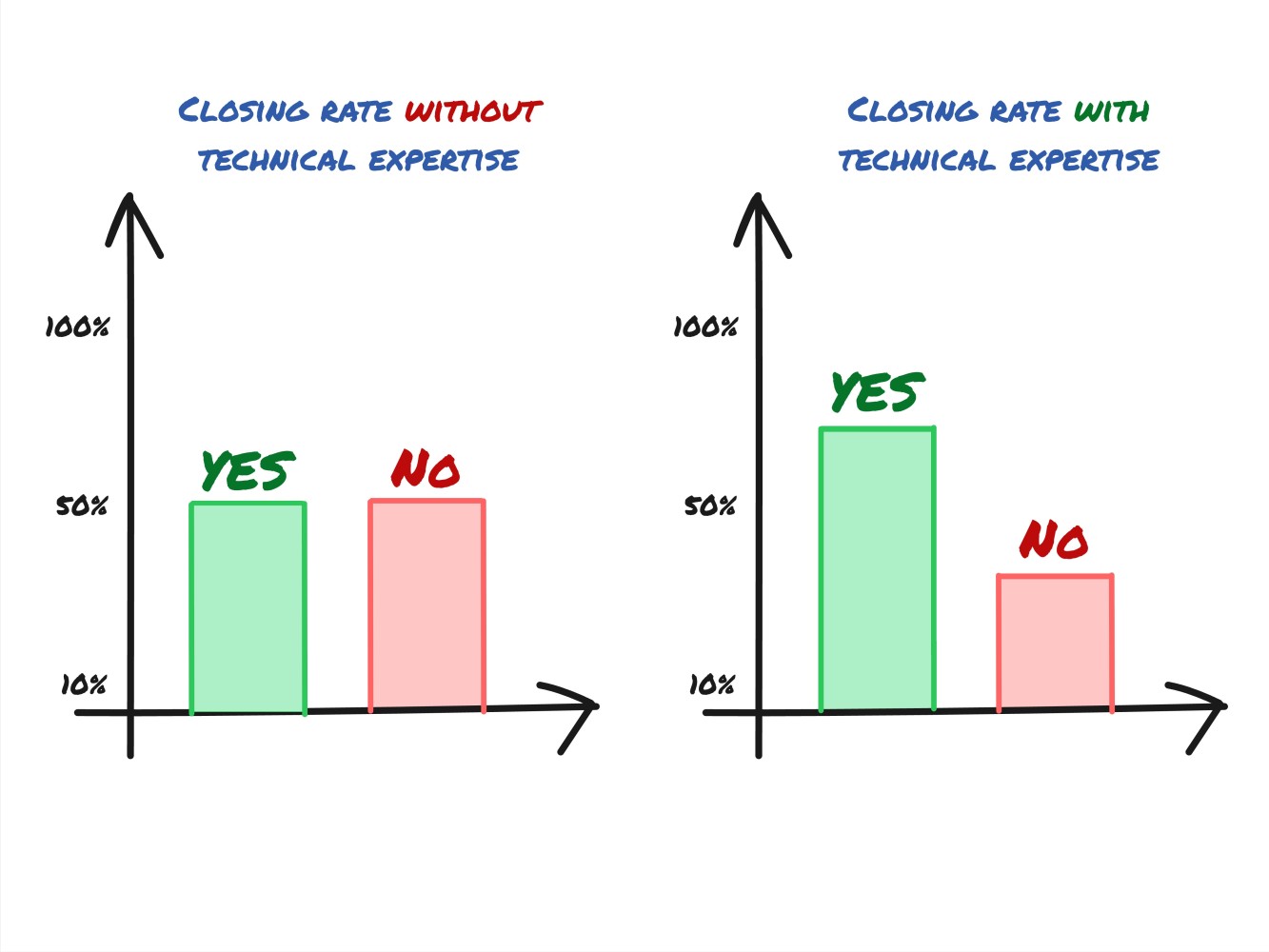
The effect was measurable.
When clients fully understand what they are buying, why it costs what it costs, and how it transforms their internal system, the probability curve shifts.
From 50/50. To 75/25, enough to create confidence in the room. And confidence closes.
Why This?
We will present our real situations over the past 5 years in the industry, where technical expertise changed the outcome of a deal.
We will talk about:
- Sales cycles that almost failed
- Technical objections that turned into leverage
- Architecture decisions that increased trust
- Pricing discussions that became strategic conversations, and yes, both sides win!
- And how integrating technical knowledge into the sales process increases closing rates
Because in complex B2B environments, persuasion alone is fragile, but understanding is powerful. And if there is one lesson we learned the hard way, it is this:
You cannot sell innovation if you cannot explain it clearly, logically, and confidently.
Welcome to Inside Cube Success Stories.


